I'm treading a fine line with this post. I don't want you, Dear Reader, to treat it as if it were a review. As you might know, I have a strict "three plays before you review" rule, and I've played
Mansions Of Madness only once. Some of the reviewers for whom I have the most respect have written very laudatory things about
Mansions Of Madness, so I'm definitely withholding any real judgment until I've played it more.
That being said, it is fair to talk about what
Mansions Of Madness represents, design-wise. It may be the game that didn't need to be made, since it crosses some boundaries that perhaps should be respected. While not everyone would consider games to be an art form, game designers can learn a few things about game genres from artistic genres.
NOT EVERY ARTISTIC EXPERIMENT IS NECESSARY
About twenty years ago, Frank Stella argued, in an article in
The New Republic (if memory serves), that some aspects of modern art were played out. Once you've challenged the assumptions behind art, what's the point of continuing to challenge them, over and over again? Marcel Duchamps signing a urinal was a profound statement. Signing it a hundred more times would be idiotic.
Yet, we've had a century of artists who keep playing with form, even though the point's already made. Every once in a while, you'll get something new. For example, the movie
Exit Through The Gift Shop made a really compelling argument that the greatness of artistic works is really just a question of perception. However, for every
Exit Through The Gift Shop, there are hundreds of works of modern art, or arty movies, or movies about modern art, that are just flogging the same point about the arbitrariness of what we think art is.
It's hard to write about art without lapsing into pompous blather. If you lasted this far, I'm sure you're wondering what Frank Stella's opinions about modern art have to do with boardgames. The line between the two is actually pretty short.
Some of the best games are the result of brave designs with form.
Up Front!, for example, threw out the map that every wargame is assumed to have.
Space Alert replaced the normal definition of a turn, the amount of time in which the player decides to act, with a fixed interval over which the players had no control.
Tales Of The Arabian Nights has a scoring system, but the real focus of the game is the stories it generates.
Cosmic Encounter threw out the idea that, in a multi-player game, everyone has to start with roughly the same capabilities.
But not every such experiment is a success. Anyone remember
Everway? If you don't, here was the premise: forget depending on the usual conventions of a role-playing game, such as having a scenario or a gamemaster. Give people cards with fantasy art, drawn at random, and let them make up their own story. Don't see many people playing
Everway these days. Come to think of it, I don't remember seeing anyone playing the game after it was first published in 1995.
Another failed experiment was the
Shadowrun giant miniature game, designed to satisfy any action figure fan's desire to set up mock battles, which is almost pointless without supplying your own sound effects (
Pew! Pew!). Which, of course, begged the question, "Why do I need help setting up mock battles and shouting
Pew! Pew!" Nice action figures, terrible and ultimately pointless game.
Just because you can play with form, doesn't mean that you should. Nowhere is that maxim more visible when people try to replicate one genre in another.
VIDEO GAME MOVIES STINK, PERIOD
Other than to make a quick buck, there's little reason to try to port the experience of a video game into a movie. If you want to pick up a controller and experience the thrill of jumping over pits, or shooting cyberdemons, or winning a martial arts bout, you'd play
Super Mario Brothers, or
Doom, or
Street Fighter. Watching someone else play one of those games is nowhere near as satisfying as playing it yourself.
Nevertheless, Hollywood producers keep trying to make a successful video game-based movie.
Here's a list from Wikipedia of movies based on video game franchises, including
Super Mario Brothers, Doom, and
Street Fighter. The one word reviews for these movies range from so boring that you couldn't watch them, even if you had nothing else to do on a six hour plane ride (
Final Fantasy), to so excruciatingly stupid that you can't even make fun of them (
Doom).
Street Fighter comes close to being unintentionally funny in an MST3K-like way, but it's instantly depressing when you realize that you're watching Raul Julia's last performance.
And here's where the whole idea behind
Mansions Of Madness seems ill-conceived. Certainly, there are some role-playing genres that can be translated into a board game. The iconic D&D dungeon crawl already feels like a commando mission, so it's not hard to turn a D&D session into a tactical boardgame. That's the direction that Wizards of the Coast already took D&D in its fourth edition, which may have offended many RPG players, but clearly has reached some market of people willing to buy all the fourth edition materials.
Because of the nature of the story in a fantasy RPG like D&D, it's not hard to translate the role-playing experience into a boardgame experience. In both cases, combat is the central mechanic of the game. Hard-fought battles between heroes and monsters, in which the heroes have a pretty good chance of winning, is the motif in both cases. While you might not like a particular D&D-like boardgame, such as C
astle Ravenloft, you might be perfectly happy with another, such as
Descent. Your choice depends on which aspects of the combat-heavy D&D experience you enjoy, and how well the designer provides them.
But that's not the type of story that the
Call Of Cthulhu RPG tells.
WHY DOES THE INDESCRIBABLE CREATURE HAVE A MINIATURE?
The tropes of the Cthulhu Mythos are so familiar, so frequently repeated across hundreds of stories, that they're practically cliche. Doomed protagonist? Check. Humanity dwarfed by cosmic horrors? Check. Sanity-shattering events? Check. Alien beings with lots of pseudopods and/or tentacles? Check.
Despite these often-repeated elements, the Cthulhu Mythos somehow avoids turning into a cliche. While it certainly helps that authors can transplant the Mythos into other settings than New England in the 1920s, that's clearly not the only reason for the Mythos' enduring appeal. Another important reason is that the Mythos is largely incomplete.
The gaps take two forms. The first isn't really relevant to
Mansions Of Madness, but I'll mention it anyway. Lovecraft hinted at a larger, more horrible universe than humans realized. Emphasis on
hinted. We never really knew much about the Great Old Ones, why they want to destroy our world when the stars are right, or even how many of them existed. When August Derleth tried to systematize the Cthulhu Mythos, he failed spectacularly, because the Mythos needed to remain unsystematized for generations of future authors to make new contributions to this enduring mini-genre.
The other gap, the scant information about any individual Mythos creature, is important for a different reason: keeping the stories scary. While Mythos fans might have the entire menagerie of Lovecraftian creatures memorized, they really have very scant information about the Mi-Go, shoggoths, or shantaks. Lovecraft's own descriptions are more suggestive, such as this description of the byakhee:
There flapped rhythmically a horde of tame, trained, hybrid winged things ... not altogether crows, nor moles, nor buzzards, nor ants, nor decomposed human beings, but something I cannot and must not recall.
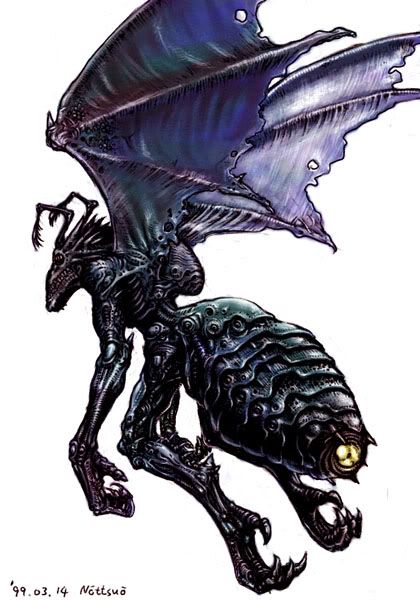
Of course, some very talented artists have tried to depict byakhee, based on those very few words. But which is more disturbing, the verbal description, which suggests something more horrible than words can capture, or even the best painting or sketch of a byakhee?
Interestingly, the least memorable of Lovecraft's own creatures was Wilbur Whateley. Despite being the offspring of Azathoth, I can't remember another instance of the bastard offspring of a Great Old One and humans, across countless Mythos stories. Poor Wilbur is a lot less interesting because Lovecraft explained him too much, leaving too little to the imagination:
The thing that lay half-bent on its side in a foetid pool of greenish-yellow ichor and tarry stickiness was almost nine feet tall, and the dog had torn off all the clothing and some of the skin. It was not quite dead, but twitched silently and spasmodically while its chest heaved in monstrous unison with the mad piping of the expectant whippoorwills outside. Bits of shoe-leather and fragments of apparel were scattered about the room, and just inside the window an empty canvas sack lay where it had evidently been thrown. Near the central desk a revolver had fallen, a dented but undischarged cartridge later explaining why it had not been fired. The thing itself, however, crowded out all other images at the time. It would be trite and not wholly accurate to say that no human pen could describe it, but one may properly say that it could not be vividly visualised by anyone whose ideas of aspect and contour are too closely bound up with the common life-forms of this planet and of the three known dimensions. It was partly human, beyond a doubt, with very man-like hands and head, and the goatish, chinless face had the stamp of the Whateleys upon it. But the torso and lower parts of the body were teratologically fabulous, so that only generous clothing could ever have enabled it to walk on earth unchallenged or uneradicated.
Above the waist it was semi-anthropomorphic; though its chest, where the dog’s rending paws still rested watchfully, had the leathery, reticulated hide of a crocodile or alligator. The back was piebald with yellow and black, and dimly suggested the squamous covering of certain snakes. Below the waist, though, it was the worst; for here all human resemblance left off and sheer phantasy began. The skin was thickly covered with coarse black fur, and from the abdomen a score of long greenish-grey tentacles with red sucking mouths protruded limply. Their arrangement was odd, and seemed to follow the symmetries of some cosmic geometry unknown to earth or the solar system. On each of the hips, deep set in a kind of pinkish, ciliated orbit, was what seemed to be a rudimentary eye; whilst in lieu of a tail there depended a kind of trunk or feeler with purple annular markings, and with many evidences of being an undeveloped mouth or throat. The limbs, save for their black fur, roughly resembled the hind legs of prehistoric earth’s giant saurians; and terminated in ridgy-veined pads that were neither hooves nor claws. When the thing breathed, its tail and tentacles rhythmically changed colour, as if from some circulatory cause normal to the non-human side of its ancestry. In the tentacles this was observable as a deepening of the greenish tinge, whilst in the tail it was manifest as a yellowish appearance which alternated with a sickly greyish-white in the spaces between the purple rings. Of genuine blood there was none; only the foetid greenish-yellow ichor which trickled along the painted floor beyond the radius of the stickiness, and left a curious discolouration behind it.
Yeesh, that's almost as long as this blog post.

For these reasons, I wonder why many people are raving (no, not in that way) about the
Mansions Of Madness miniatures. While I'm not a huge fan of two-dimensional depictions of the Mythos menagerie, I'm really turned off by three-dimensional ones. At least with 2D images, you can get a little crazy with what you're depicting. In 3D, you're stuck with what's not only possible, but reasonable to manufacture as a plastic miniature. The shoggoth in
Mansions Of Madness looks more like a potato angry for being left out in the sun too long than an indescribable horror, and that might be the best anyone can do with a miniature.
By the way, the principle of leaving a lot to the imagination is hardly unique to Lovecraft. Some of the best horror movies don't show much of the monster, if anything. In the first
Alien movie, we never get a really good look at the creature. (In fact, we're so ignorant of its anatomy that we're surprised as Ripley is when it uncoils from its hiding place in the shuttle.) The monster in
Curse of the Demon was pretty frightening until the very end of the movie, when the filmmakers decided to show it. Ditto for the monster in
Forbidden Planet. The original
Cat People was a very disturbing story, without ever showing Simone Simon turning into a panther, or even seeing the panther at all except for a couple of scenes.
So, I'm not thrilled with the miniatures. Coulda done without 'em. But you might make a similar complaint about
Arkham Horror, which has way more pictures of Mythos creatures than
Mansions Of Madness ever will, even after the inevitable expansions. But there's one key difference between those two games: Arkham Horror is not trying to be the boardgame equivalent of the
Call Of Cthulhu role-playing game.
SUSPENSE DEPENDS ON THE UNEXPECTED
From its first edition onwards,
Call Of Cthulhu has always stood apart from most other RPGs (except, perhaps, for other horror RPGs, many of which have tried to capture what made CoC great). Our beloved memories of a game like D&D usually center on epic battles, fought at high risk for high stakes, in which Our Heroes usually emerge victorious. The memorable moments in
Call Of Cthulhu involve people dying in horrible ways (dissolving into piles of goo, pulled beneath the waves, swallowed whole by an amorphous horror, etc.), or things going catastrophically wrong (framed by cultists, allowed a major villain to escape, went insane at an extremely inopportune moment, etc.).

While the game is designed to deliver these outcomes,
Call Of Cthulhu also benefits from the unbounded nature of role-playing games. There is no winning or losing, though there may be outcomes that are more desirable than others. Players will do the darndest things, often making horribly bad decisions or dice rolls, or pulling out brilliant improvisations at a critical moment. If the campaign is going in a bad direction, the GM can make adjustments before running the next session.
In fact, "campaign" is another way of saying that CoC is, to use James Carse's term,
an infinite game. The point of the game, as is the case with RPGs in general, is continuing to play the game. While the appeal of continued play might take different forms, with different RPGs, in the case of CoC, it's the delicious anticipation of what will happen next. While CoC usually falls under the category of horror RPGs, suspense plays just as great a role in CoC.
The contrast with
Mansions Of Madness is pretty clear. While MoM tries to be a story-telling game, it's a consummately finite game. You play a scenario, and then you're done. You either win or lose. There might be story-telling elements available in the game, in the form of flavor text or clues, but you can easily lose track of these elements, especially since the game keeps you focused on its mechanics, such as finding clues and solving puzzles. In CoC, the story-telling is more important than the mechanics.
While MoM begs this comparison,
Arkham Horror does not, because
Arkham Horror is not trying to be Call Of Cthulhu in a box. It's clear from the very beginning that the meaning of AH is not the same as CoC, even though the theme is the same. (In fact, AH might be one of the best illustrations of the difference between theme and meaning,) The theme of both CoC and AH is the Cthulhu Mythos. The meaning of AH, the experience or mechanics that the game mechanics create, is a race against time that the players can easily lose. That's not the meaning of CoC in general (though individual sessions might have that motif). AH never tries to be frightening, or horrifying, or morally disturbing.

To achieve its aims, AH does not need to be open-ended. In fact, fudging is equivalent to cheating. Many of the principles of good RPGs,
as discussed in this excellent presentation, would only serve to make an already lengthy game even longer, perhaps to an intolerable degree. (So forget about creating sandboxes or showmanship.) The final bit of advice, "Enable risk-taking," is completely irrelevant, since winning AH depends on minimizing risks.
In contrast, any game that tries to be "CoC in a box" must heed these principles of running a good RPG. Which, more or less, means that not being an RPG is a bit of a problem. Since CoC is all about storytelling, in which the worst outcomes (or the risk of them) are sometimes the most desirable, it's far less suited to translation into a boardgame than D&D and many other types of RPG.
AN UNSPEAKABLE GAME THAT SHOULD NOT BE!
And now we return to our discussion of art. In modern art, or game design, it might be interesting for the artist or designer to experiment with form. However, not every experiment, including ones that might be successful from a strictly technical perspective, are necessarily interesting or even meaningful for the audience.
In one of the most memorable sessions of CoC with my long-lost game group, I found myself arguing on one side of a moral dilemma with another player character. A typical Unspeakable Creature That Should Not Be was rampaging through an insane asylum, located on a lonely, storm-swept island where we were all stranded. Faced with the likelihood that we were all going to die, my PC took a strictly utilitarian view:
I have a spell that will summon another creature, under my control, which might defeat the one about to kill us. Unfortunately, the spell requires a human sacrifice. But we're all going to die, including that senile octagenarian in the wheelchair over there. So...The other PC had a much, much different view. Sure, we were all going to die, but once you start trafficking with the Great Old Ones, even worse things than death might result.
That's the kind of moment that makes CoC a fantastic RPG. While I might have lost the ability to sustain the commitment needed for a regular RPG group, I still remember our CoC sessions with great fondness. That's an experience, and a memory, that I fear MoM can never create.
[P.S. For a similarly skeptical view of
Mansions Of Madness,
pass through this interdimensional portal to Chris Farrell's blog.]






 And then online play continues until someone finds a new imbalancing strategy.


